

Office-Based Hemorrhoid Procedures: Banding, Sclerotherapy and More
Office-based procedures are usually the first step when internal hemorrhoids keep causing symptoms despite conservative care. They are done in the doctor's office, generally without anesthesia, and recovery is much easier than after hemorrhoid surgery. Here is how the main options compare and who each one suits.
When is an office-based procedure recommended?
Office-based treatment is meant for people with symptomatic internal hemorrhoids (grades I, II or III) that have not improved with conservative treatment such as fiber, fluids and medication. All these procedures work in a similar way: they cause the excess hemorrhoidal tissue to shrink away, and healing and scarring then anchor the remaining tissue in place.
A review of randomized trials found that surgical hemorrhoidectomy caused more pain and more complications than rubber band ligation. For that reason, an office-based procedure is generally tried first, even for grade III hemorrhoids, and surgery is kept for cases where office treatment does not control the symptoms.
Some situations go straight to surgery: grade IV internal hemorrhoids, external hemorrhoids, mixed internal and external hemorrhoids, or hemorrhoids that come with other anal problems. Office-based procedures do not treat the external component of a hemorrhoid, such as a skin tag, so your doctor will explain this before the procedure.
Rubber band ligation
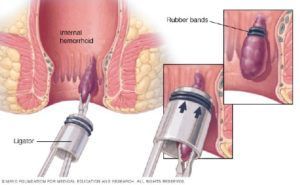
Rubber band ligation is the most commonly used technique for bleeding internal hemorrhoids. It is effective, inexpensive and rarely causes serious complications. People with grade II or III internal hemorrhoids are the best candidates.
- How it is done: through a small scope (anoscope), the doctor places a small rubber band at the base of the hemorrhoid. The tissue loses its blood supply and falls away over the following days, leaving a small area that heals over several weeks.
- Anesthesia: when performed properly it does not require anesthesia. The band must go on above the sensitive area of the anal canal; if you feel intense pain, the band is repositioned or removed right away.
- Sessions: usually one hemorrhoid column is treated at a time, and repeat sessions, if needed, are spaced three to four weeks apart so swelling and ulceration can settle. Some people feel anal or rectal "tightness" afterward.
- Results: in a large series of 805 patients, treatment was considered successful in about 71 percent, and in about 80 percent when repeat treatment was included. Results tend to fade somewhat over longer follow-up.
Bands are generally not used in people who take blood thinners or antiplatelet drugs, who have a coagulation disorder, cirrhosis or portal hypertension, because of the risk of delayed bleeding. They are also relatively avoided in people with weakened immune systems because of infection risk. Tell your doctor about every medication you take, including aspirin.
You can read more in our posts on how rubber band ligation works, who needs it and what to expect, and recovering at home after banding.
Possible complications after banding
- Pain: the most frequent complication, in roughly 8 percent of patients.
- Delayed bleeding: can happen when the band comes off, usually two to four days later, or when the treated area sloughs, five to seven days later. It can be significant in people with clotting problems.
- Thrombosis of nearby hemorrhoids: this can cause pain or a lump.
- Infection: persistent pain, fever or foul-smelling rectal drainage can signal an infection that needs prompt attention.
- Rare events: serious infection (sepsis) and difficulty urinating have been reported but are uncommon.
Sclerotherapy
In sclerotherapy, the doctor injects a solution into the tissue around an internal hemorrhoid. The solution causes an inflammatory reaction that destroys the redundant tissue. Like banding, it is done through an anoscope and does not need anesthesia.
It is used for grade I and II bleeding internal hemorrhoids, with reported success rates of 75 to 89 percent, although recurrences are more common than with banding. Bleeding afterward is rare. That makes sclerotherapy especially useful for people who take anticoagulant or antiplatelet drugs, who have portal hypertension, or who are immunocompromised. Complications are uncommon and usually minor, such as mild discomfort or bleeding at the injection site. Rare serious problems can occur if the solution is injected into the wrong tissue.
Infrared coagulation
Infrared coagulation applies infrared light, converted into heat, to the base of an internal hemorrhoid for about two seconds, with three to five applications per hemorrhoid. The treated area turns white, then forms a scab, and over one to two weeks the tissue retracts. It is suited to grade I or II bleeding internal hemorrhoids. It is sometimes mistakenly called "laser therapy," but it is not a laser.
Compared with banding, infrared coagulation causes less discomfort right after the procedure and fewer complications, but symptoms return more often. Banding also tends to need fewer treatment sessions.
Other techniques
Other methods, such as electrotherapy, bipolar energy, laser and cryosurgery, can also be used for grade I and II internal hemorrhoids. Laser hemorrhoidectomy and cryosurgery do not appear to offer clear advantages, and they have higher costs or more complications and lower patient satisfaction.
Thrombosed external hemorrhoids
A thrombosed external hemorrhoid (a painful clot) can be removed in the office if you are seen within the first three days of symptoms. After that, symptoms usually start to fade on their own and typically disappear in 7 to 10 days. Large or bleeding clots may need surgical removal in an operating room.
Which procedure is right for you?
The choice first depends on which procedures are available locally. When several are possible, banding is generally preferred for healthy patients with grade I to III internal hemorrhoids because it is more effective and needs fewer sessions. Sclerotherapy is suggested for people who cannot safely have banding, such as those on blood thinners.
Care after an office-based procedure
After any of these procedures you will be advised to avoid constipation with stool softeners, plenty of water and a high-fiber diet. Warm sitz baths and oral pain medication can help with discomfort. Rarely, a serious infection can develop; call right away if you have severe pain, difficulty urinating and fever together.
Talk to Dr. Erick Alayo at Gastro SB
If hemorrhoids are bothering you, an evaluation will tell which option fits your case. Learn more about hemorrhoid treatment at Gastro SB or read our guide on hemorrhoid diagnosis and treatment, from home care to surgery. To schedule a visit with Dr. Erick Alayo in Chula Vista, call (619) 382-3315 .
Source: summary of published medical literature on office-based hemorrhoid procedures, including a Cochrane review of randomized trials, rewritten in our own words. For educational purposes only; it does not replace a medical evaluation.
Gastro SB Clinic offers comprehensive treatment for a wide range of gastrointestinal and nutritional conditions.