

Hemorrhoid Diagnosis and Treatment: From Home Care to Surgery
Most hemorrhoids can be managed with home care, and only a small percentage of people need surgery. This guide walks through how hemorrhoids are diagnosed and the treatment options, from simple remedies to office procedures and surgery.
Home Remedies
Mild pain, swelling and inflammation can often be relieved at home. Symptoms frequently go away within a week.
- Eat high-fiber foods. More fruits, vegetables and whole grains soften the stool and add bulk, which helps you avoid the straining that worsens hemorrhoids. Add fiber slowly to avoid gas.
- Use topical treatments. Over-the-counter hemorrhoid creams or suppositories with hydrocortisone, or pads with witch hazel or a numbing agent, can help.
- Take warm sitz baths. Soak the anal area in plain warm water for 10 to 15 minutes, two to three times a day.
- Take oral pain relievers temporarily, such as acetaminophen, aspirin or ibuprofen.
See your doctor if you do not get relief within a week, or sooner if you have severe pain or bleeding.
Medications
For mild discomfort, a doctor may suggest over-the-counter creams, ointments, suppositories or pads containing ingredients such as witch hazel, hydrocortisone or lidocaine, which temporarily relieve pain and itching. Do not use an over-the-counter steroid cream for more than a week unless your doctor directs it, because it can thin the skin.
External Hemorrhoid Thrombectomy
If a painful blood clot forms inside an external hemorrhoid, your doctor can remove it for prompt relief. The procedure is done under local anesthesia and works best when performed within 72 hours of the clot forming.
Minimally Invasive Procedures
For persistent bleeding or painful hemorrhoids, these procedures can be done in the office or another outpatient setting and usually do not require anesthesia.
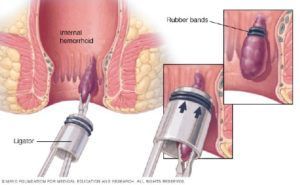
- Rubber band ligation: one or two tiny rubber bands are placed around the base of an internal hemorrhoid to cut off its circulation, and it falls off within a week. It can be uncomfortable and may cause bleeding two to four days afterward, which is rarely severe. More serious complications are occasional.
- Injection (sclerotherapy): a chemical solution shrinks the hemorrhoid tissue. It causes little or no pain but may be less effective than banding.
- Coagulation (infrared, laser or bipolar): light or heat makes small, bleeding internal hemorrhoids harden and shrivel. It has few side effects and usually little discomfort.
Surgical Procedures
If other procedures have not worked or the hemorrhoids are large, a doctor may recommend surgery.
- Hemorrhoidectomy: the surgeon removes the excess tissue that causes bleeding, using local anesthesia with sedation, spinal anesthesia or general anesthesia. It is the most effective and complete treatment for severe or recurring hemorrhoids. Most people have some pain afterward, which medication and warm baths can ease. Temporary difficulty emptying the bladder can occur, mainly after spinal anesthesia.
- Hemorrhoid stapling (stapled hemorrhoidopexy): blocks blood flow to hemorrhoidal tissue and is typically used only for internal hemorrhoids. It generally involves less pain and a faster return to regular activities, but compared with hemorrhoidectomy it has been linked to a greater risk of recurrence and rectal prolapse. Other possible complications include bleeding, urinary retention, pain and, rarely, a life-threatening blood infection.
Preparing for Your Appointment
Make a list of your symptoms and how long you have had them, your usual bowel habits and fiber intake, and all medications, vitamins and supplements with doses. Useful questions for your doctor include:
- What is the likely cause of my symptoms?
- Is my condition likely to be temporary or permanent?
- What treatment do you recommend, and what comes next if it does not work?
- Am I a candidate for surgery, and why or why not?
- What self-care steps might help?
Expect to be asked how uncomfortable your symptoms are, what your bowel habits and fiber intake are, what improves or worsens symptoms, whether anyone in your family has had hemorrhoids or colon, rectal or anal cancer, whether your bowel habits have changed, and whether you have seen blood on the toilet paper, in the toilet or in your stools. Until your visit, soften your stools with more fiber (food or a supplement) and six to eight glasses of water a day.
Next Steps
Learn how to recognize the different types in our guide to hemorrhoid symptoms, types and when to see a doctor, or visit our hemorrhoid treatment page. To schedule a consultation with Dr. Erick Alayo in Chula Vista, call (619) 382-3315.
Source: adapted from Mayo Clinic patient information on hemorrhoid diagnosis and treatment, rewritten in our own words. For educational purposes only; it does not replace a medical evaluation.
Gastro SB Clinic offers comprehensive treatment for a wide range of gastrointestinal and nutritional conditions.