

Hemorrhoids: Types, Grades and Treatment Options
Hemorrhoids are abnormal swelling of the vascular cushions in the anal canal and one of the most common causes of rectal bleeding. They often improve on their own, and when they do not, effective treatments are available. This article explains how hemorrhoids are classified and how each type is usually treated. To learn about our care, visit hemorrhoid treatment at Gastro SB.
How hemorrhoids are classified
Hemorrhoids are described by where they sit in relation to the dentate line, a landmark inside the anal canal.
- Internal hemorrhoids lie above the dentate line. The tissue here is less sensitive to pain, so many internal hemorrhoids can be treated in the office with little or no anesthesia. They are graded from I to IV according to how far they prolapse (protrude) from the anal canal.
- External hemorrhoids lie below the dentate line, where the tissue is more sensitive. When symptomatic hemorrhoids of this type do not respond to conservative care, they are generally treated surgically under anesthesia. A small, recently formed thrombosed (clotted) external hemorrhoid is an exception and can sometimes be treated in the office.
- Mixed hemorrhoids straddle the dentate line and are usually treated like external hemorrhoids.
First step: conservative treatment
For symptomatic hemorrhoids, the first approach is dietary: enough fluids and fiber. Most people with low-grade (I or II) internal hemorrhoids improve with this alone and need nothing more. See a gastroenterologist if hemorrhoids are persistent or complicated, or if there is rectal bleeding that may call for a colonoscopy.
Office-based procedures
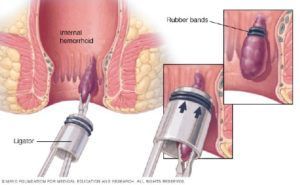
For grade I, II or III internal hemorrhoids that do not improve with conservative care, an office-based procedure is generally preferred over surgery as the first intervention, because most cause less pain and fewer complications. Common options are rubber band ligation, sclerotherapy and infrared coagulation.
- Rubber band ligation is usually the preferred choice for otherwise healthy patients because it is more effective and needs fewer sessions than the alternatives.
- It is not suitable for people who take anticoagulant or antiplatelet medication, have a weakened immune system or have portal hypertension. In these patients, sclerotherapy is generally suggested because it has been better studied in this group.
When surgery is needed
Surgical hemorrhoidectomy is offered to patients with grade IV internal hemorrhoids, those with combined internal and external hemorrhoids and significant prolapse, and those who have another reason for anorectal surgery, when conservative treatment has failed.
Thrombosed external hemorrhoids
A newly thrombosed external hemorrhoid can be removed in the office if the patient is seen within the first three days of symptoms. After that, symptoms usually begin to ease and typically fade in 7 to 10 days. Large or bleeding thrombosed hemorrhoids may need removal in the operating room.
Learn more
Source: general information adapted from UpToDate (Wolters Kluwer) clinical content on hemorrhoid classification and treatment, rewritten in our own words. Educational only; it does not replace medical advice.
Gastro SB Clinic offers comprehensive treatment for a wide range of gastrointestinal and nutritional conditions.